From the raw genome
to the signed report.
Traceable genomic interpretation that makes evidence — and uncertainty — visible.
One connected workflow for analysis, annotation, ACMG interpretation, pharmacogenomics and polygenic risk, preserving the evidence and the professional decision behind every reported finding.
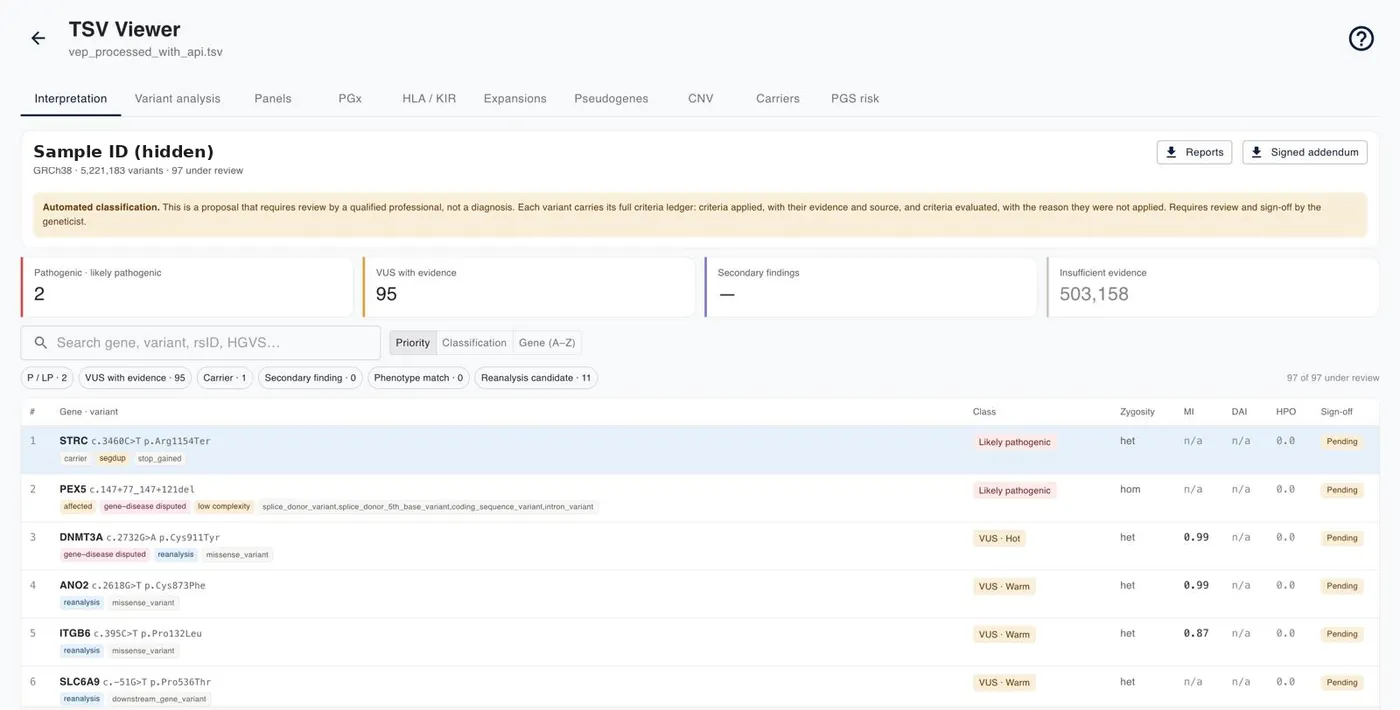
What the geneticist reviews before signing
Every finding ranked, with its ACMG class, zygosity and sign-off status. Nothing is issued as a result until a professional signs.
An unresolved region should never look like a confirmed normal.
Conventional short-read workflows can struggle in highly homologous regions, structural events and areas with ambiguous coverage. When those limits are not made explicit, an unresolved region looks indistinguishable from a supported negative result.
Innovare surfaces coverage, mapping quality and unresolved evidence throughout the workflow, so a professional can tell a supported negative from a region that was never resolved.
Illustrative technical scenario.
CYP2D6 is one example of a wider class of loci where conventional short-read workflows fail silently.
| Locus | Why conventional workflows fail | What Innovare does |
|---|---|---|
| SMN1 / SMN2 | Near-identical paralogs: read depth miscounts copies. | Dedicated copy-number calling, with the residual carrier risk stated. |
| GBA / GBAP1 | Recombinant alleles are split between the gene and its pseudogene. | Locus-specific haplotype analysis across the homology region. |
| PMS2 (exons 9, 11–15) | More than 95% identity with its pseudogene. | Declared not evaluable on short reads, instead of a silent normal. |
| Copy-number & structural variants | Depth reflects mappability as much as dosage. | Multi-evidence detection, ClinGen-based scoring, filtered events accounted for. |
| Repeat expansions | Expansions exceed the read length. | Detection against curated thresholds; unresolvable loci reported as “cannot be stated”. |
Every result states its boundary.
A negative is only as wide as what was assessed. For each analysis, Innovare shows what was evaluated, what was filtered out and why, and what was not looked at — so “normal” is never confused with “not assessed”. Loci that short reads cannot resolve are declared, not guessed.
What a silent false normal actually looks like
A pipeline that does not treat the CYP2D6 locus specifically does not return an error. It returns *1/*1 — a poor metaboliser reported as normal, with the same appearance of certainty as a real result.
CYP2D8P–CYP2D7–CYP2D6 locus at 22q13.2. Above, a conventional germline path: reads falling in the near-identical blocks shared with the CYP2D7 pseudogene have no unique destination, receive MAPQ 0 and carry no usable evidence. Below, the same material after a specialised locus-specific analysis. Schematic representation; metrics measured on our own samples. Full method in technical note NT-PGX-001.
One connected chain, from raw reads to signed report
Ingest
FASTQ, BAM, CRAM, VCF, gVCF — single or multiple runs
Align & call
Alignment and calling, with quality and coverage recorded per region
Annotate
Clinical databases and population frequencies
Interpret
ACMG engine, polygenic risk and CYP2D6 pharmacogenomics
Review & sign
Geneticist curation, read-level inspection, immutable signature
Depth where it matters
Every module is built to be inspected, not trusted blindly.
Pharmacogenomics with explicit confidence
21 pharmacogenes assessed against CPIC, DPWG and FDA guidance. A gene is reported only when every position that defines its alleles is covered: genes with one or two unconfirmed positions are shown as “evaluated with caveat”, naming the positions and the reason, and the rest as “not evaluable”. CYP2D6 is resolved with copy number and structural alleles on whole-genome data. Drug recommendations are searchable by drug or gene.
CPIC · DPWGFDA labellingACMG classification engine
A Bayesian ACMG interpretation model aligned with ClinGen SVI recommendations, which records every criterion applied — and every one deliberately not applied — as an auditable ledger. It includes a full PVS1 decision tree, gene–disease validity gates drawn from ClinGen and GenCC, call-quality gates and an anti-double-counting rule, and flags variants in difficult genomic regions for the reviewing geneticist.
ClinGen SVIGenCCauditable ledgerAncestry-calibrated polygenic risk
Scores computed against reference panels, with explicit ancestry inference for Iberian and admixed Latino populations.
275+ traitsEmbedded read-level viewer
Inspect any variant against the aligned reads inside the portal, alongside an interactive workspace for filtering, shortlisting and exporting findings.
read-levelsee the workspaceCoverage decides what is reported
When effective coverage does not reach threshold, the gene is not reported. The rule is enforced consistently before reporting.
not evaluable ≠ normalCuration, signature & addendum
The geneticist edits the classification, records the criteria and signs. Signed content becomes immutable; later changes are issued as a traceable addendum.
immutable signatureBeyond single-nucleotide variants
Copy-number, pseudogene and repeat-expansion analysis run on whole-genome data. Where an analysis type does not include a layer, it is declared as not included rather than shown as empty.
CNV/SV
Whole-genome detection combining read-depth and breakpoint evidence. A finding requires agreement between at least two methods. Losses and gains are classified with the ClinGen/ACMG technical standard for copy-number variants, with the score broken down criterion by criterion. Common population events, low-mappability regions and artefacts are filtered explicitly, and the workspace shows how many were removed and why. Chromosomal sex is inferred and atypical sex-chromosome complements are flagged.
ClinGen/ACMG CNVfilter funnelGenes with pseudogenes
SMN1/SMN2 copy number and GBA/GBAP1 recombinant alleles are resolved with dedicated whole-genome methods. Where the biology defeats short reads, as in the homologous exons of PMS2, the report says so. A normal SMN1 copy number is never read as ‘not a carrier’: the residual risk is stated.
SMN1/SMN2GBAPMS2 boundary declaredRepeat expansions
Whole-genome screening of clinically curated loci against published thresholds, with benign, intermediate and pathogenic ranges. Loci that short-read sequencing cannot support are reported as ‘cannot be stated’ rather than forced into a number. Every positive is flagged for orthogonal confirmation.
curated thresholdsHLA typing
HLA typing from raw reads or aligned BAM, with a sub-panel for alleles linked to severe drug hypersensitivity (abacavir, carbamazepine, oxcarbazepine, phenytoin, allopurinol, dapsone), mapped to CPIC guidance and FDA labelling. Loci without sufficient depth are reported as not evaluable. Positives require allele-specific confirmation.
hypersensitivity panelBuilt on validated open bioinformatics standards, and aligned with ACMG/AMP, ClinGen SVI and CPIC/DPWG.
Measured, and written up as dossiers
Every figure below comes from a self-contained study with a documented method, a defined acceptance criterion and a traceable dataset.
Directional concordance is computed only over variants where both the reference and the engine reached a conclusive call, and covers SNV and indels annotatable by the engine. These are analytical validation figures against reference truth sets and expert-panel classifications. Methodology, confusion matrices and discordance annexes are documented and available on request.
What the platform does today
Every capability listed here is in production and available for use.
Declared use reflects intended purpose. Laboratories validate the software within their own quality system and remain responsible for the clinical interpretation and signature of every report.
How a laboratory adopts it
The scientific differentiation matters only if it survives contact with a real laboratory.
Deployment
Cloud-hosted multi-tenant portal in EU regions. No local analysis infrastructure to provision.
Onboarding
Guided setup on your own cases, with your gene panels and report layout.
Validation support
Dossiers and reference-set results for your quality system. Your laboratory owns the validation.
Versioning & reanalysis
Every run records pipeline and knowledge-base versions, so a case can be reanalysed and compared.
Access & security
Named accounts, role-based access, tenant isolation and an immutable signature record per report.
Support
A named technical contact through onboarding and scientific support for interpretation questions.
One review workspace for sequence variants, copy number, pseudogenes, repeat expansions, HLA, pharmacogenomics, polygenic risk and carrier status. The geneticist reviews, edits and signs; the platform proposes.
Or send us the case, and we sign the report
A complete diagnostic service for clinics that want the result rather than the platform. Start from your own sequencing data or from a sample — the interpretation is ours, and it is signed.
Preventive Exome
Genetic risk factors in a person with no symptoms, so prevention can be planned on evidence.
Exome Focus & panels
Phenotype-driven analysis, or a curated panel when the differential is already narrow.
Carrier screening
Autosomal recessive and X-linked carrier analysis, individually or as a couple, with gene–disease validity and the combined and residual risk made explicit. On whole-genome data, complemented by SMN1 copy number for spinal muscular atrophy.
Pharmacogenomics
Pharmacogenomic assessment across 21 genes with CPIC, DPWG and FDA-based recommendations, including CYP2D6 structural analysis and an HLA hypersensitivity panel on whole-genome data.
Interpretation from your own sequencing data takes 7 working days; cases that start from a sample take longer. The clinical decision, consent and genetic counselling stay with the referring professional.
Declared purpose — General Laboratory Use (GLU)
Innovare is supplied as General Laboratory Use software. It is a genetic-interpretation support tool: it does not constitute a direct clinical diagnosis or a therapeutic recommendation, and it does not issue a clinical result autonomously. Results require professional review and signature before any clinical use.
The laboratory validates the software within its own quality management system and remains responsible for the interpretation, the report and the signature.
See it run on your data
Bring one representative case — ideally one where you suspect the answer was never actually computed. We will show you what the chain resolves, and what it declares as not evaluable.